
When Great Content Fails the “Plumbing” Test
In B2B SaaS, we widely adopt this principle attributed to Bill Gates: “Content is King.” It serves as a mantra. We spend weeks crafting white papers and thousands on guest posts. But in my years conducting Digital Marketing Audits, I’ve noticed a recurring tragedy: brilliant content trapped in a broken library.
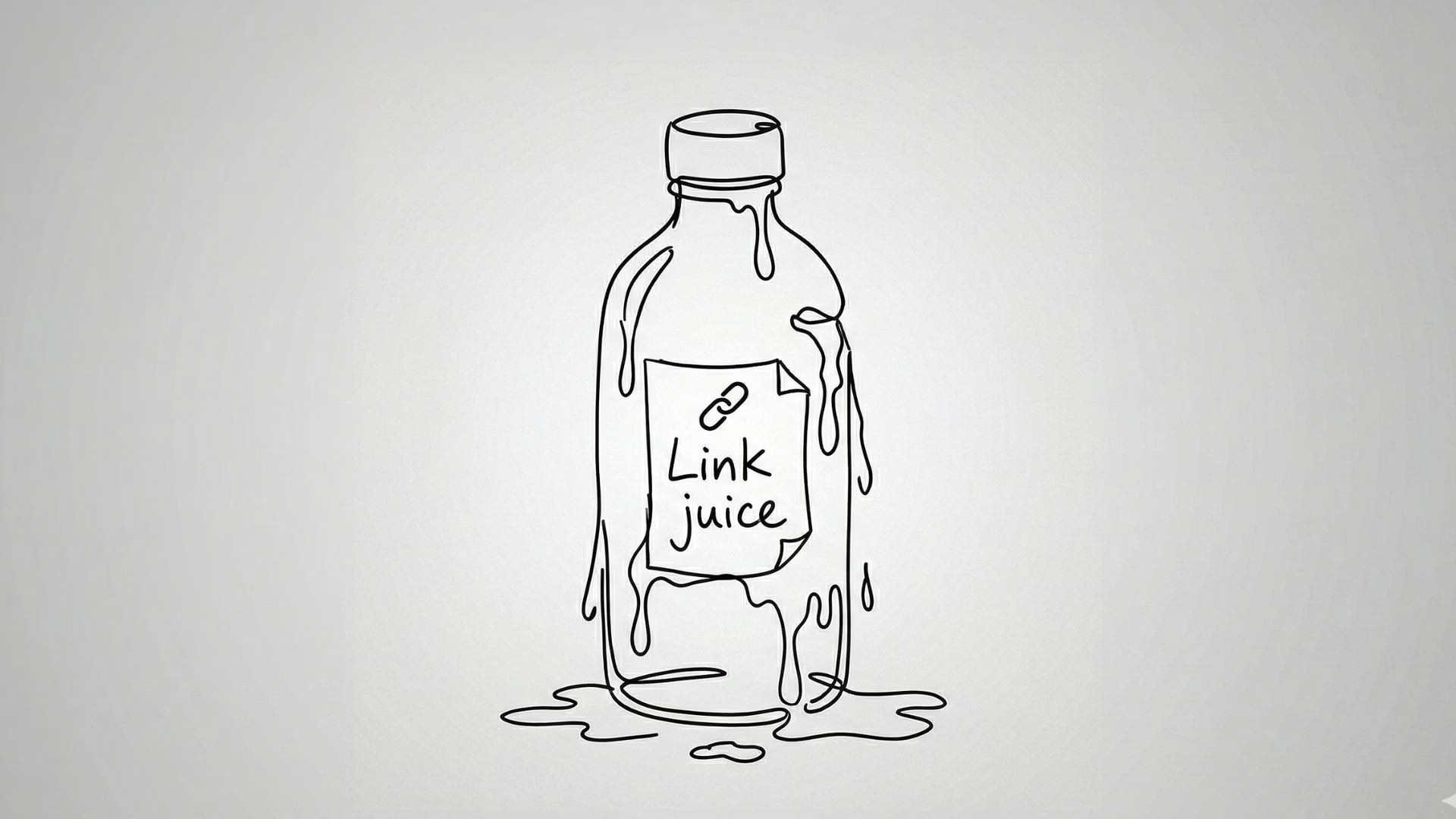
If Strategic Architecture is the soul of your brand, Search Architecture is the plumbing. You can have the highest-quality water (content) in the world, but if your pipes (internal links and structure) are leaking, that authority never reaches your “Money Pages.”
In the era of GenEO (Generative Engine Optimisation), structural integrity isn’t just about ranking on page one; it’s about being “machine-readable” so AI agents can navigate your expertise.
Key takeaways
- AI Amplifies Strategy, It Doesn’t Replace It. Many organisations mistakenly view generative AI as a patch for under performing marketing. The reality is that AI acts as an accelerator. If applied to a fundamentally sound strategy, it accelerates growth. If applied to a leaky funnel or untrusted data, it will only accelerate waste and damage brand authority faster.
- The Shift from “Search” to “Answer” Optimisation. The era of optimising solely for “ten blue links” is ending. We are entering the age of “Answer Engines,” where platforms provide singular, synthesised responses rather than lists of websites. Winning in this environment requires a fundamental shift in how you structure content and data so that your brand is cited as the definitive source of truth by these engines.
- 3. The “Cathedral Principle” is Non-Negotiable. In a rapidly changing technological environment, short-term patches are failing faster than ever. Sustainable B2B growth now requires a commitment to deep foundational health. You must commit to the unglamorous work of a comprehensive audit today to ensure your infrastructure can support the weight of tomorrow’s innovations.
Based on my experience, and, to be honest, my readings, I would like to share 7 signs that your website’s structural integrity is compromised – and how to fix the leaks.
1. The “Orphanage” Effect (Orphan Pages)
An orphan page is a piece of content that exists on your server but has zero internal links pointing to it. Think about this (almost) fictional example: you published a great case study six months ago, and it has zero organic visits (that’s the symptom).
Without a link from a “Parent” or “Sister” page, search bots (and AI agents) struggle to find the content. More importantly, no authority flows to it (and this is the leak).
How can you fix this leak? Every new piece of content must be “born” with at least three internal links from existing authoritative pages.
2. The “Shallow Silo” (The Missing Cocoon)
A Shallow Silo is a high-level Pillar Page that lacks sufficient supporting detail provided by linked Satellite Pages. This structure signals surface-level knowledge rather than deep, specialised expertise in a sub-topic. We often see B2B sites with a massive “Ultimate Guide” (Pillar Page) but no supporting “Satellite” content.
Imagine an “Ultimate Guide to Cloud Security” (Pillar Page). A shallow silo would be if this guide only links out to a single page titled “What is a Firewall?” and nothing else. A robust, deep silo would link to dedicated, in-depth articles on “Zero Trust Architecture,” “Compliance Standards (HIPAA, ISO 27001),” and “Serverless Security Risks.”
We’ve identified the symptom: the pillar page ranks for broad terms but fails to convert or rank for specific, high-intent long-tail queries. And here is the leak: authority isn’t a one-way street. A Semantic Cocoon requires a web of related sub-topics to prove to Google (and users) that you are a deep expert, not just a surface-level generalist.
To fix the leak, you need to build out at least 5-7 “Satellite” pages that explore specific facets of your main pillar. Note that some experts name them “daughter pages” too.
3. Anchor Text Anemia
Anchor text is the clickable, visible text in a hyperlink. Its primary function is to provide context and descriptive information to both users and search engines about the page being linked to.
In many cases, internal links use words like “Click here,” “Read more,” or “This post”. Sometimes, it fully makes sense when you want to distribute content from a menu page. You cannot detail on the main page all the content you share on the profound pages. But sometimes only. You have to keep in mind that bots crawl your website; when they can’t distinguish which page is the primary authority for a specific topic, it becomes a problem (the symptom).
Anchor text is a signpost. When using a generic text, it tells the search engine nothing about the destination: that’s a leak. Remember how bots crawl your site: you keep reading a page when they find it “interesting” from a user perspective.
There is an easy fix: you can use descriptive, keyword-rich anchor text. Instead of “Click here,” use “Learn more about our [SaaS Scalability Framework].” You can also add a hyperlink to your text when it’s explicit enough.
4. The “Broken Circulatory System” (Redirect Chains)
Redirects are a mechanism used to send a user or a search engine bot to a different URL than the one they originally requested. They are essential for website maintenance, especially when URLs change, pages are merged, or content is moved.
In marketing, we update URLs often. But these updates frequently leave behind a trail of redirects. If your website feels sluggish, your crawl is being wasted. Crawl budget refers to the amount of resources (time and effort) that Google is willing to spend crawling a website. It is the number of URLs a search engine bot (like Googlebot) can and wants to crawl on a given site within a certain timeframe. Here’s the symptom.
You identify the leak every time “Link Juice” passes through a redirect (301), a tiny bit of authority is lost. If you have a chain (Page A -> Page B -> Page C), the authority is heavily diluted.
To fix this, you have to audit your redirects. Always link directly to the final destination URL. You can even redirect multiple old or shallow pages to one single one.
5. High Traffic, Zero Intent (Topical Mismatch)
“Link Juice” is a colloquial but widely understood term in SEO (Search Engine Optimisation) used to describe the value, authority, and ranking power passed from one webpage to another through hyperlinks. Think of it as a form of digital currency or energy flow. When a reputable, high-authority page links to one of your pages, it is effectively “sharing” some of its accumulated authority (PageRank) with your page. While “Link Juice” is the classic term, industry professionals often now refer to it as Link Equity or Authority Flow.
Sometimes a site ranks incredibly well for a “viral” topic that has nothing to do with the core software product. The symptom? You have a large number of monthly visitors but zero demos booked.
Your structure is attracting the wrong “juice.” If your architecture links heavily to irrelevant fluff, you are signalling to AI models that you are an “entertainment” site rather than an “IT Solution” authority. It’s where the traffic of your website leaks.
How to fix this? Tighten your Internal Mesh. Ensure your most authoritative blog posts link directly to relevant product or service pages.
6. The “Content Island” (Lack of Vertical Maillage)
Maillage interne is the internal linking structure of a website. Vertical Maillage specifically connects high-level Pillar Pages to lower-level Satellite Pages, ensuring efficient authority flow and deep topical coverage. We often see blog sections that are completely disconnected from the main product navigation.
The typical symptom occurs when users read a blog post and then bounce immediately. It happens when there is no bridge between your “Educational” content and your “Commercial” solution (the leak).
To fix this leak, you can implement “Breadcrumbs” and ensure your sidebar or bottom-of-post CTAs are contextually linked to your internal silos.
7. Machine-Invisibility (Lack of Semantic Clarity)
Semantic clarity ensures AI models can instantly map the relationship between content elements (headings, text, data) to trust your site as a verifiable, authoritative source. As we transition to GenEO, AI models look for structured data and clear hierarchies (H1 > H2 > H3).
The main symptom you may experience can turn into a massive frustration: you search ChatGPT or Perplexity for your niche, and they cite your competitors, even if your content is better.
The reason-why it happens is due to the messy architecture of your content (the leak). If an AI can’t instantly map the relationship between your sub-headers and your main topic, it won’t trust you as a citation source.
Use a strict heading hierarchy and implement Schema Markup to “label” your expertise for the bots (the fix).

Ready for a Structural Integrity Audit Check-up?
Structural integrity is the silent driver of visibility. If you suspect your link juice is leaking, a standard SEO “checklist” won’t fix it. You need an architectural map.
← Back to the Citadel of Content
FAQs about the Structural Integrity Audit
Is “Link Juice” still relevant in 2026?
Absolutely. While the terminology has evolved into “Link Equity” or “Authority Flow,” the principle remains: search engines use links to determine which pages are most important.
How often should I audit my Search Architecture?
For a growing SaaS company, a deep structural audit should be performed at least once a year, or whenever you undergo a significant content pivot.
Does GenEO replace standard SEO?
No, it evolves it. GenEO requires the same structural integrity as SEO but demands higher clarity and verifiable expertise (E-E-A-T).