In the current era of search, keywords alone are no longer enough to win. While standard SEO guides—like Backlinko’s Google E-E-A-T: How to Create People-First Content—do an excellent job of defining the basics, B2B companies need to take these principles a step further.
With the rise of AI-generated content and the shift toward GenEO (Generative Engine Optimization), Google has doubled down on its E-E-A-T framework. For B2B organizations, this isn’t just a checklist; it is the framework that determines whether your brand is seen as an industry leader or just background noise.
Key takeaways:
- E-E-A-T is a Credibility Framework: It stands for Experience, Expertise, Authoritativeness, and Trustworthiness. It’s not a numerical score, but a set of signals Google uses to separate high-quality content from low-value “noise.”
- The “Experience” Factor: The newest “E” (Experience) is vital for B2B. It’s about proving first-hand, real-world application rather than just theoretical knowledge.
- Trust is the Priority: Of the four pillars, Trustworthiness is the most critical. This is established through transparent sourcing, secure sites, and clear author credentials.
- B2B Stakes are Higher (YMYL): Because B2B decisions involve high costs and business stability, they often fall under Google’s “Your Money or Your Life” (YMYL) category, meaning they are held to much higher accuracy standards than general content.
- Essential for GenEO: In the era of Generative Engine Optimization, AI models (like Gemini or Search Generative Experience) prioritize citing sources with high E-E-A-T. To be the “answer” provided by an AI, your content must be verifiable and authoritative.
What is Google E-E-A-T?
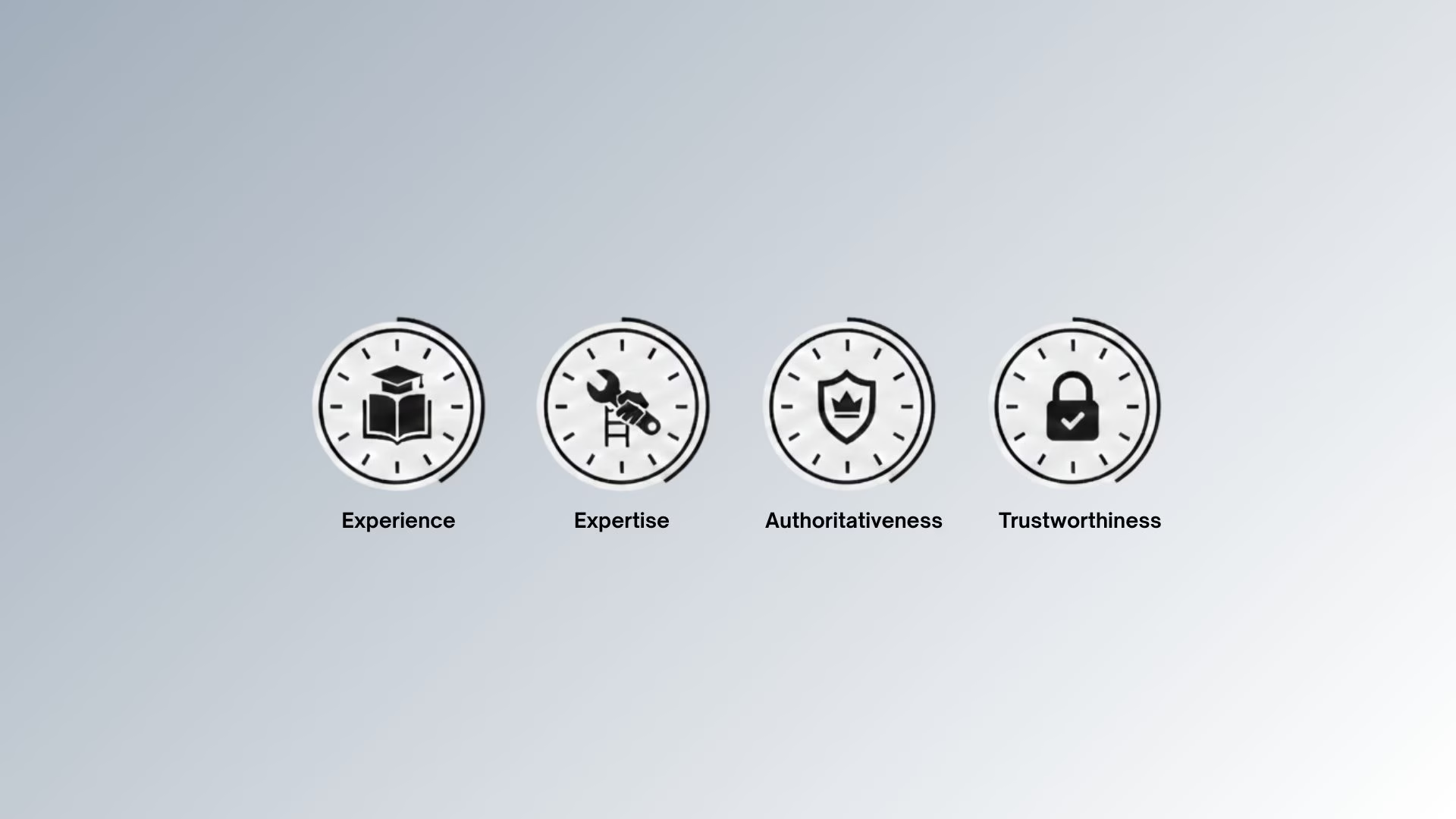
E-E-A-T stands for Experience, Expertise, Authoritativeness, and Trustworthiness. While it is not a “score” you can find in a dashboard, it is a set of signals Google uses to evaluate the quality of your content. E-E-A-T is a fundamental concept within Google’s Search Quality Rater Guidelines, which are used by human reviewers to assess the quality of search results. These quality raters do not directly influence search rankings, but their feedback helps Google refine its ranking algorithms.
The emphasis on these four pillars is crucial for any content creator aiming for high visibility and user trust.
- Experience refers to the value of direct, first-hand experience with the topic. For example, a product review is much more valuable if the writer has actually purchased and used the item. It demonstrates that the content is based on practical knowledge, not just theory or aggregation of other sources.
- Expertise relates to the knowledge and skill of the content creator in a particular field. This is often demonstrated by credentials, professional experience, education, or simply a consistently deep understanding of the subject matter. For topics related to health, finance, or safety (known as “Your Money or Your Life,” or YMYL topics), high levels of expertise are essential.
- Authoritativeness is about the recognition and respect the content creator or the website has within the industry or among other experts. It’s a measure of reputation. A site’s authoritativeness is often built through external validation, such as links from other authoritative sites, mentions in respected media, and positive public perception.
- Trustworthiness is arguably the most critical component, acting as the foundation for the other three. It signifies that the content is accurate, honest, safe, and reliable. Trust is built through transparent sourcing, factual accuracy, secure website protocols (HTTPS), and clear, accessible contact or ‘About Us’ information. For e-commerce sites, a clear refund policy and secure payment options contribute to trustworthiness.
By consistently demonstrating strong E-E-A-T, content creators signal to Google that their content is high-quality, reliable, and provides genuine value to the user, ultimately leading to better search performance.
Why Google E-E-A-T is critical for B2B
The B2B buying journey is fundamentally different from B2C, characterized by being exceptionally long, complex, and high-stakes. Unlike a B2C “impulse” purchase, a B2B acquisition—whether a major software platform, a long-term service contract, or specialized equipment—represents a significant financial and operational risk to the purchasing organization. For content creators, Google’s E-E-A-T (Experience, Expertise, Authoritativeness, and Trustworthiness) framework is not merely an SEO best practice; it is the essential mechanism for mitigating this inherent risk and winning buyer confidence.
Here is an elaborated breakdown of how E-E-A-T directly addresses the unique challenges of the B2B buying cycle:
High-stakes decisions and the YMYL category (Your Money or Your Life)
In the B2B context, the “Your Money or Your Life” (YMYL) designation is exceptionally relevant. While YMYL typically relates to health and financial advice for individuals, it applies broadly to B2B software and services because they directly impact a business’s stability, financial health, security, and operational viability.
- Financial Impact: Choosing the wrong ERP system, CRM, or marketing automation platform can lead to millions in lost revenue, failed implementations, and major project delays. Content must be held to the highest possible standards of accuracy, currency, and verifiable data to protect the buyer from poor decisions.
- Operational Risk: A vendor’s technical documentation, best-practice guides, or security policy descriptions must be impeccable. Any inaccuracy can expose the purchasing company to security breaches, compliance failures, or operational downtime. E-E-A-T ensures that the content is authored by genuine experts who understand the gravity of these system-level implications.
Building unshakeable buyer confidence and demonstrating a partnership mindset
B2B decision-makers are not merely looking for a commodity or a quick fix; they are seeking a reliable, long-term partner. In complex sales, Trustworthiness (the “T” in E-E-A-T) is paramount because the relationship often spans years, involving deployment, training, support, and strategic road mapping.
- Beyond Summarization: Generic, surface-level content suggests a lack of depth and investment. When a brand demonstrates E-E-A-T, they show they aren’t simply summarizing publicly available information or using generic AI text. They are presenting a proven methodology, proprietary insights, and evidence-based solutions that only come from years in the field.
- The Authority of Proof: Authority is built through external validation. This includes case studies with quantifiable ROI, verified third-party reviews, and content cited by respected industry analysts (e.g., Gartner, Forrester). This evidence provides the objective social proof necessary for the multiple stakeholders in the buying group to align and approve the purchase.
Humanizing the brand and validating real-world experience (The Extra ‘E’)
In the age of scalable content generation, buyers are increasingly skeptical of text that feels generic or algorithmically generated. The “Extra E” – Experience – is the critical differentiator that bridges the gap between theoretical knowledge and practical application, allowing a brand to connect on a human level.
Practical validation
Experience refers to the first-hand, practical skill and familiarity with the topic. For B2B, this means showcasing content written by the people who actually implement the software, run the campaigns, or manage the security infrastructure. This depth is demonstrated through:
- Detailed, ‘How-To’ Guides: Content that anticipates and solves obscure edge cases.
- Behind-the-Scenes Insights: Sharing lessons learned from failed projects or successful pivots.
- Expert Authorship: Clearly attributing content to named individuals (engineers, consultants, strategists) with verifiable credentials and public profiles.
Building a connection
Humanizing the brand through demonstrable, named expertise builds a connection that an anonymous, perfectly optimized algorithm simply cannot replicate. It moves the vendor from an abstract entity to a collective of knowledgeable people, fostering the emotional trust required before a major contract is signed.
The rise of GenEO: Winning in the age of generative AI search
As the digital landscape evolves, so too does the nature of search. Google’s strategic shift toward AI-powered results, exemplified by features like AI Overviews, signals that we are rapidly transitioning into the age of GenEO (Generative Engine Optimization). This new paradigm fundamentally changes how content is discovered, evaluated, and presented to users.The Shift from Ranking to Synthesis
Traditional Search Engine Optimization (SEO) focused on getting a link to rank highly on a results page. Generative engines—such as Google’s Gemini, Perplexity, and the ubiquitous ChatGPT—do not merely “rank” links; they synthesize comprehensive answers. These sophisticated AI models are trained on vast datasets and are specifically engineered to prioritize and extract information from the most authoritative, trustworthy, and expert sources.
Consequently, content that lacks clear, verifiable signals of trust and credibility is becoming invisible in this new era. If your content is missing robust E-E-A-T (Experience, Expertise, Authoritativeness, and Trustworthiness) signals, the AI engine is far less likely to cite your brand, domain, or specific article as the basis for its synthesized answer. In GenEO, a piece of content must not just be relevant; it must be demonstrably the most reliable source available.The GenEO Imperative: “Show Your Work”
To thrive and win in the GenEO environment, content creators must embrace a new mandate: you must systematically “show your work.” This goes beyond simply mentioning an author’s name; it requires providing unambiguous, machine-readable proof of the content’s quality and verifiable origin.
To be deemed a high-trust source by generative AI models, your content strategy must incorporate the four following elements:
Original research and proprietary data
AI engines heavily favor unique, first-hand information. Presenting proprietary surveys, original datasets, exclusive interviews, or novel findings establishes you as the primary authority on a subject, making your content essential for the AI’s synthesis.
Verifiable author credentials
Ensure that every piece of content related to a sensitive topic (YMYL – Your Money or Your Life) is attributed to a genuine expert. This requires clear author bios that link to external, verifiable proof of expertise, such as professional certifications, academic degrees, peer-reviewed publications, or LinkedIn profiles.
Comprehensive case studies and proof points
Instead of making broad claims, ground your arguments in detailed, well-documented case studies and concrete examples. These not only provide excellent user experience but also offer the AI tangible evidence—the “proof” it needs—to validate your content’s accuracy.
Expert quotes and citations
Integrate direct quotes from recognized, independent experts in the field. Furthermore, properly citing external sources that are themselves high-E-E-A-T entities bolsters your own content’s authority, indicating a commitment to thorough, evidence-based reporting.
By strategically building these verifiable signals into the core of your content, you transition from competing for a rank to competing for the AI’s trust. This fundamental shift ensures that your brand and content are not merely found, but actively cited and relied upon as the most reliable source available, a critical differentiator in the generative search landscape.
How B2B companies can improve their Google E-E-A-T
To meet Google’s high standards for quality content, especially in YMYL (Your Money or Your Life) topics, it’s crucial to proactively demonstrate Experience, Expertise, Authoritativeness, and Trustworthiness. This involves moving beyond surface-level content creation and implementing strategic transparency and verification across your site.
Demonstrate expertise and experience
Elevate the perception of the individuals creating your content from mere “writers” to certified and recognized Subject Matter Experts (SMEs).
Optimize and expand author bios:
- Beyond the Name: A simple name is insufficient. Every author bio should be a verifiable professional summary.
- Professional Credentials: Link directly to the author’s active professional profiles (e.g., LinkedIn, professional society pages, public research profiles).
- Quantify Experience: Clearly state the author’s years in the industry (e.g., “15 years as a certified financial planner,” “Senior Data Scientist since 2011”).
- List Certifications and Awards: Prominently display relevant, current certifications (e.g., CPA, PMP, AWS Certified, PhD). Include links to the issuing body where appropriate for verification.
- Internal Verification: For complex or technical topics, implement a clear system where your in-house engineers, consultants, or legal teams provide quotes, data verification, or formally review and approve the final piece. This should be explicitly noted on the article (“Reviewed by: Dr. Sarah Chen, Chief Medical Officer”).
Show, don’t just tell (The “Experience” element):
- Concrete Examples: Move past abstract advice. Use specific, detailed case studies and anonymized project examples to illustrate successful application of the advice.
- Visual Proof: Integrate high-quality, relevant media like screenshots, proprietary data visualizations, flowcharts, or “behind-the-scenes” photos/videos of your team or process. This validates that the advice comes from actual practice.
- Methodology Transparency: For data-driven content, clearly explain your data collection methods, sources, and analytical approach.
Cultivate authoritativeness and trustworthiness
Authority is built over time through consistency, transparency, and a commitment to factual accuracy and currency.
Implement a robust content governance policy:
- Regular Content Audits and Updates: Content decay is a major trust killer. Establish an annual or semi-annual review process for all pillar and top-performing content.
- Refresh Data and Insights: Trust is immediately lost when a buyer sees “2022 Trends” in 2026. Prioritize updating statistics, citing new research, and reflecting the current state of the industry.
- Display Review Dates: Use a visible “Last Updated” or “Fact-Checked On” date, demonstrating a continuous commitment to accuracy.
- Transparent Sourcing: Use high-quality, reputable, and diverse sources. Link out to primary research, academic papers, government reports, and established industry leaders. Avoid linking to low-authority or self-published sources.
- Establish a “Trust” Page: Create dedicated pages detailing your editorial guidelines, fact-checking process, privacy policy, and corporate values. This centralizes signals of trustworthiness.
Build your site’s reputation (external authority):
- Secure Mentions and Citations: Actively seek mentions, citations, and links from high-authority sources in your industry (e.g., universities, respected news outlets, industry associations).
- Highlight Awards and Recognition: Prominently display any awards, certifications, or regulatory compliance seals relevant to your business or industry.
- Client Testimonials and Case Studies: Incorporate genuine, detailed client testimonials and public case studies that showcase real-world results and demonstrate the practical impact of your expertise.
Conclusion
Google E-E-A-T is the bridge between being an “option” and being an “authority.” For B2B companies, it is the most sustainable way to survive algorithm updates and lead the conversation in the age of AI search.
FAQs About Google E-E-A-T
Is E-E-A-T a direct ranking factor or a score?
No, E-E-A-T is not a direct score. It is a framework of signals used by Google’s quality raters to help refine the algorithms that determine content quality and trust.
How does GenEO (Generative Engine Optimization) relate to E-E-A-T?
GenEO relies on E-E-A-T. Generative AI prioritizes citing the most authoritative, trustworthy, and expert sources, meaning high E-E-A-T content is critical for visibility.
Why is the “Experience” (the extra E) crucial for B2B content?
Experience demonstrates first-hand, practical knowledge. It bridges the gap between theory and application, building trust with buyers skeptical of generic or AI-generated content.
Does YMYL (Your Money or Your Life) apply to B2B?
Yes, YMYL is highly relevant. B2B decisions affect a company’s financial stability and operational viability, requiring content to meet the highest standards of accuracy and expertise.